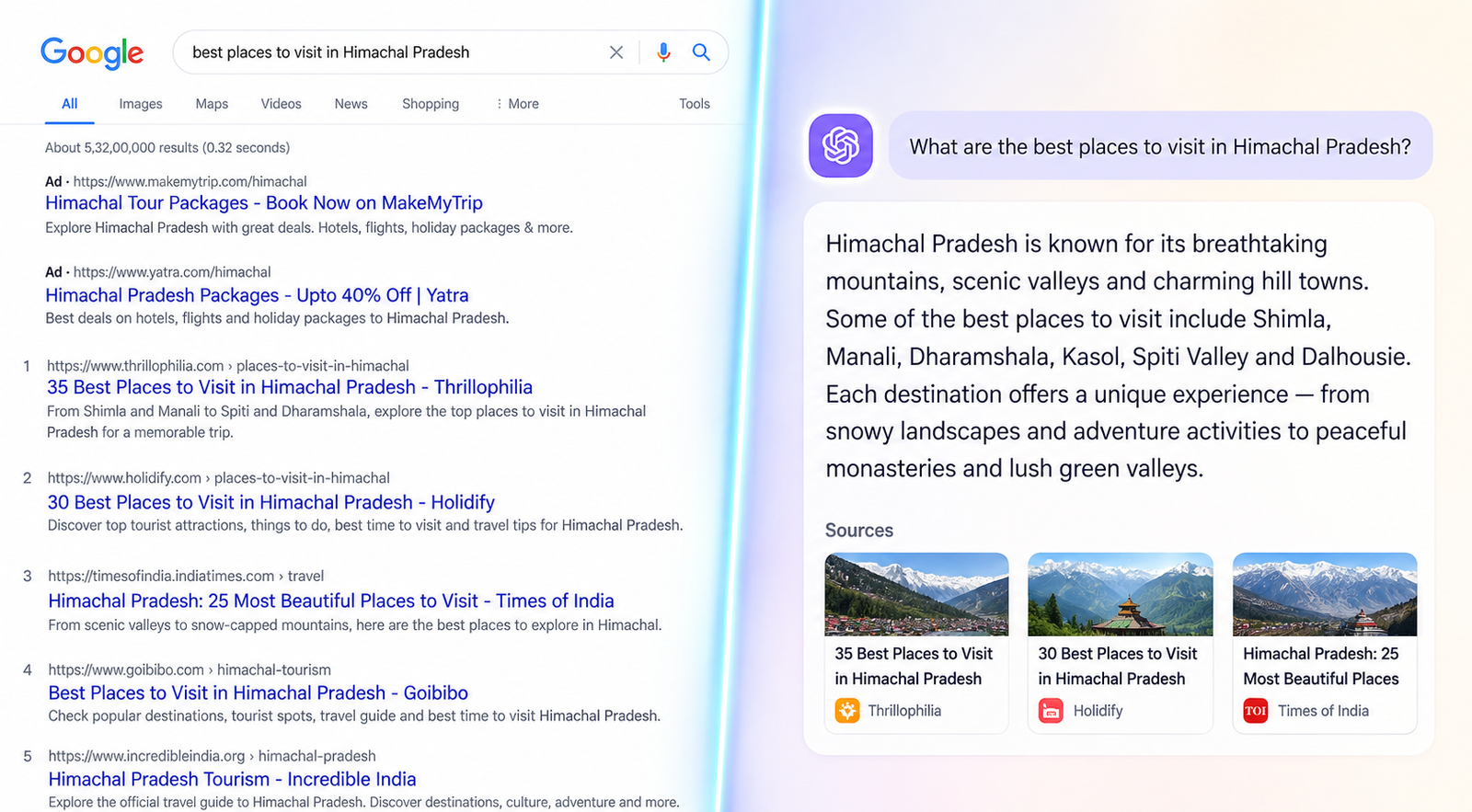
A few months ago, one of our trainees asked a question that stuck with us:
"If ChatGPT already gives me the answer, why would I ever open a website again?"
It wasn't a rhetorical question. She genuinely wanted to know. And honestly, it's the same question every business owner, marketer and developer should be asking right now.
At MindSprout, we work with AI every day. We build it, train people on it, and watch how it changes the way people find information. Search is where the change is most visible. Let's break it down.
Two Very Different Ways of Finding Answers
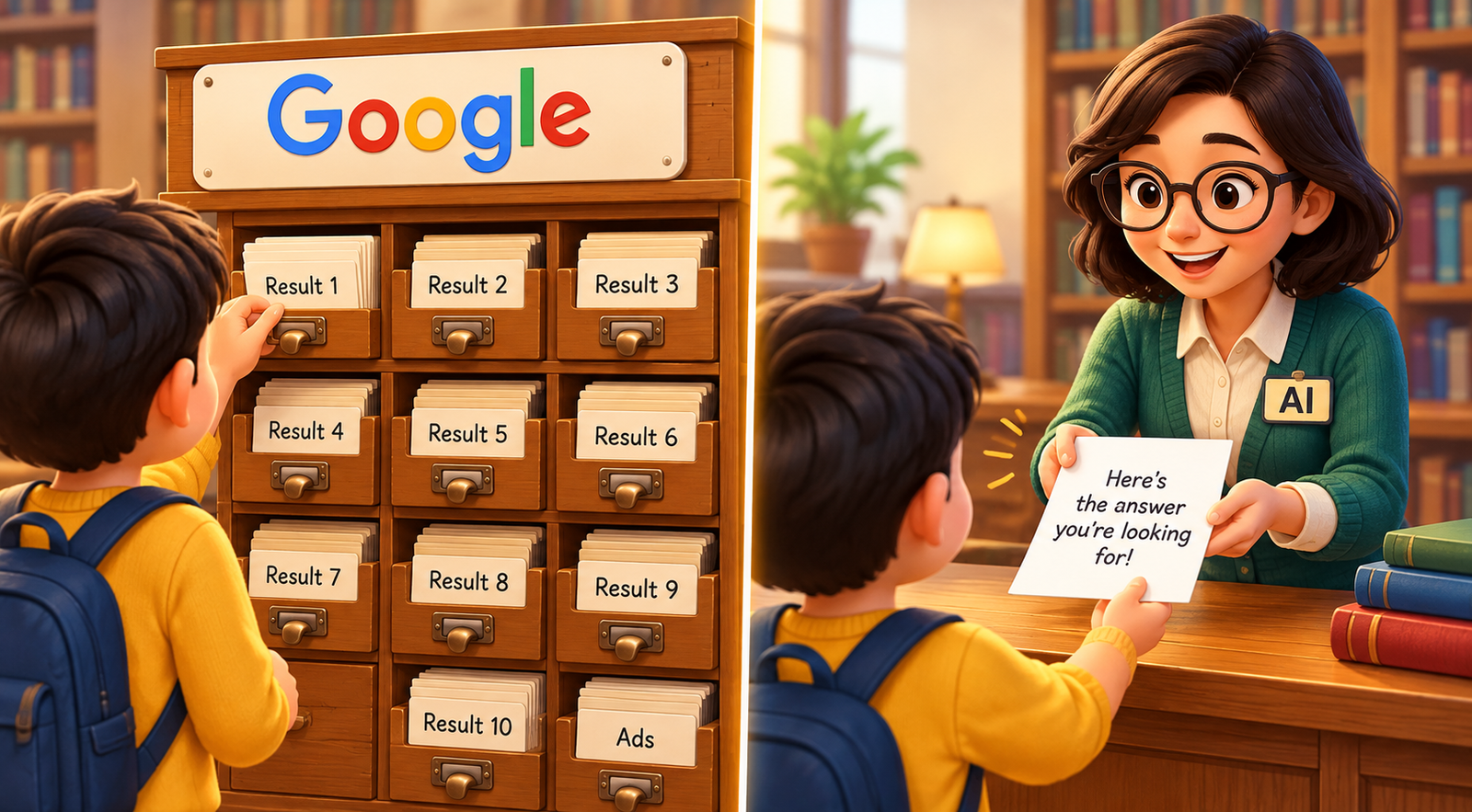
The easiest way to understand the difference is to think of a library.
Google Search is the card catalogue. You type a few keywords, and it shows you a ranked list of pages that might contain your answer. You still do the work: open a few links, compare, decide.
Generative AI search is the librarian. You ask a full question, and it reads many sources for you, then writes a single answer in plain language. Sometimes it shows where the information came from. Often, you never open those sources at all.
Google itself now sits in both worlds. Its AI Overviews appear at the top of many results pages, and its separate conversational AI Mode has grown fast: AI Mode crossed 1 billion monthly users by May 2026, up from 75 million daily active users less than a year earlier. Meanwhile, ChatGPT has surpassed 1 billion weekly active users as of August 2026, according to OpenAI.
For Indian businesses in particular, this isn't a far-away trend. India reached 100 million weekly ChatGPT users after the launch of ChatGPT Go in early 2026.
Example 1: Same Question, Two Experiences
Try this yourself. Type the same need into both tools.
"AI training institute Mohali"
You'll typically see sponsored ads at the top, a Google Maps local pack with a few listings, and a long list of websites. You scroll, open three tabs, compare reviews, and hunt for fees and syllabus manually.
"I'm a working professional in Mohali and want to learn data science on weekends. Which institutes should I consider and what should I check before joining?"
You get a short, organized answer. It mentions a few institutes, explains what to check (curriculum, live projects, mentor pedigree, placement assistance), and cites a handful of websites.
Notice the difference? On Google, every institute that ranks on page one gets a chance to be clicked. In the AI answer, only a few names are mentioned at all. If your business isn't one of them, you don't exist in that conversation.
What the Numbers Are Telling Us
This shift isn't just a feeling. The research data has been consistent all year:
That sounds scary, and for some websites it is. But there's an important detail inside the data: being cited in the AI answer still matters a lot. Seer Interactive found that when an AI Overview appears, pages cited in it receive around 2.1% CTR, compared with about 0.9% for pages that aren't cited.
And the traffic that does come from AI tools tends to be far more serious. Industry data suggests traffic referred from ChatGPT, Perplexity, and Gemini converts at roughly 3 to 5 times the rate of generic Google organic traffic. Why? Because the AI has already pre-qualified the user's intent before they ever click. Fewer visitors, but much higher-intent buyers.
"The fundamental question of digital marketing changes from: 'How do we rank?' to: 'How do we become the source the AI trusts and quotes?'"
Example 2: Keywords vs. Conversations
People don't search the same way anymore.
AR app development cost
Short, impersonal, fragmented query designed for a machine index.
"How much does it cost to build an AR app for a real estate project in India, and how long does it usually take?"
Rich in context: specific industry, country, budget concern, and project timeline.
The second question is longer, more specific, and full of context. AI search engines handle these questions with ease, and users are rapidly adopting this habit.
For your business content, this means a landing page that simply repeats the phrase "AR app development cost" ten times will no longer help. A page that clearly and transparently answers the real question — breaking down cost factors, technology stacks (WebAR vs. Native Unity), real-estate use cases, and delivery timelines — has a vastly superior chance of being indexed and quoted.
Example 3: Writing Content an AI Can Actually Use
Here is a common problem we see on business websites across India and worldwide. Imagine an educational institute's "About Us" section:
"We are a leading, innovative and trusted institute providing world-class education solutions to students across diverse domains with a commitment to excellence."
Sounds pleasant, but contains zero factual substance. No AI can quote this because it answers nothing.
"We offer weekend data science and Python courses in Mohali for working professionals. Each batch has 20 students, runs for 12 weeks, and ends with two real-world capstone projects that students can add to their portfolio."
Answers exactly who it is for, location, curriculum, duration, batch size, and practical takeaways. Exactly what AI engines look for!
Example 4: Give the Machines Some Structure
A clear FAQ section is one of the simplest and highest-leverage wins you can implement today. Answer real questions your customers ask, in plain language.
Developers can go a step further and implement structured schema data (Schema.org JSON-LD) so that web crawlers and LLM retrieval engines understand your content with complete semantic clarity:
{
  "@context": "https://schema.org",
  "@type": "FAQPage",
  "mainEntity": [{
    "@type": "Question",
    "name": "How long does it take to build a WebAR experience?",
    "acceptedAnswer": {
      "@type": "Answer",
      "text": "A simple WebAR experience usually takes a few weeks, depending on 3D content, interactions and testing across devices."
    }
  }]
}
It isn't magic, and it won't guarantee an instant citation. But it makes your content exponentially easier to read for both Google's search crawlers and AI reasoning systems, which is the entire objective.
What Still Hasn't Changed
Before anyone rushes to "throw out SEO," a reality check is needed.
AI search engines still crawl, parse, and pull from the open web. Pages that load fast, are technically easy to crawl, contain honest, expert first-hand content, and earn backlinks from trusted authorities will always outperform low-quality pages — both on Google and in AI answers.
The Evolution of Search Optimization
Old SEO asked: "Can we get the click?"
New SEO also asks: "Can we be the answer, even when there's no click?"
You will hear new industry buzzwords like GEO (Generative Engine Optimization) and AEO (Answer Engine Optimization). Don't get lost in the acronyms. At their core, they simply mean: writing with clarity, demonstrating genuine domain authority, and structuring your digital assets so machines can understand and trust them.
A Practical Checklist
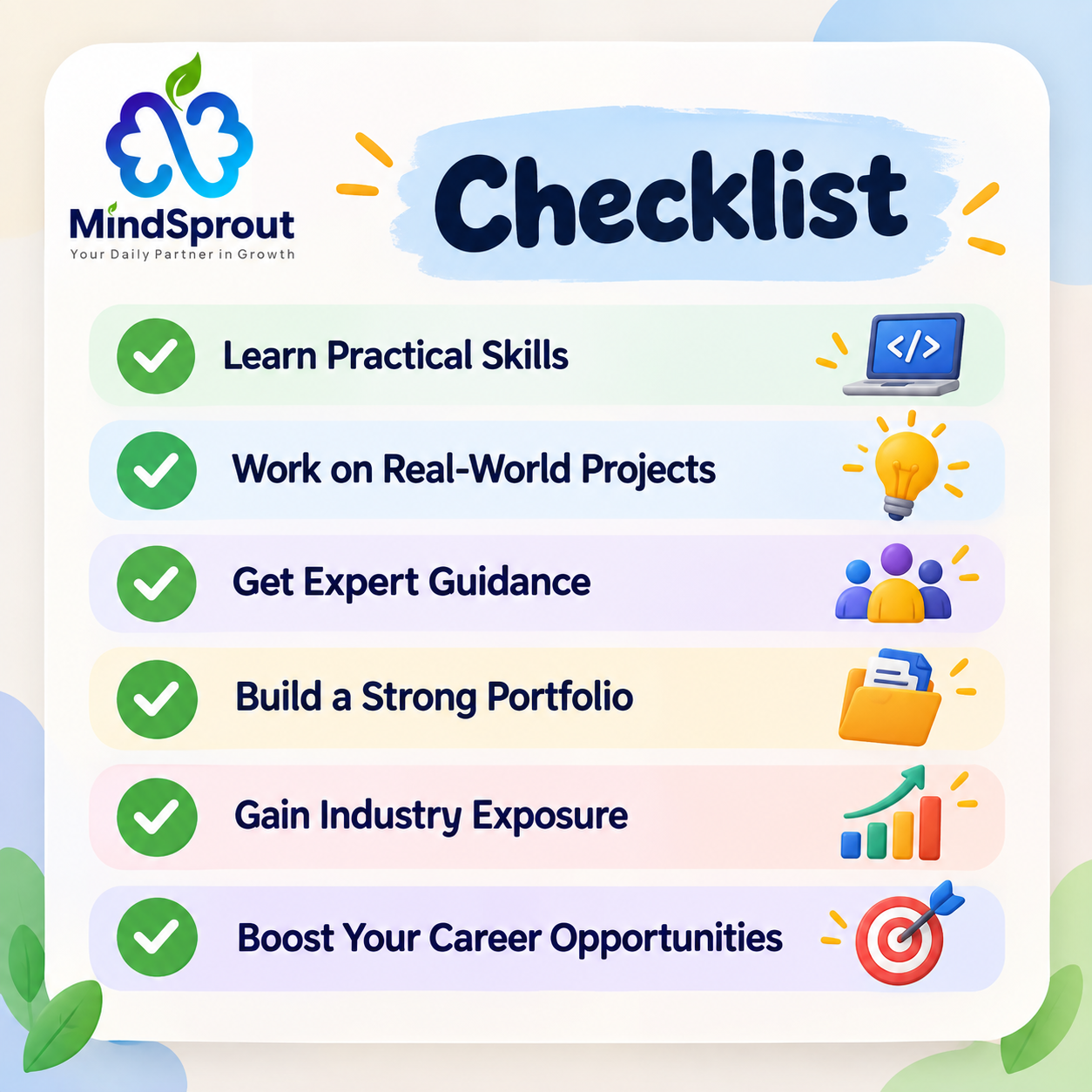
Here is an actionable roadmap designed by MindSprout Technologies for teams looking to future-proof their web presence:
For Business Owners & Marketers
- Answer Upfront: Rewrite key pages to answer customer questions directly in the first 2-3 sentences.
- Provide Concrete Specifics: Include exact locations, timelines, steps, pricing ranges, and real outcomes.
- Build a WhatsApp & Call FAQ: Transform actual questions asked by leads into a comprehensive FAQ section.
- Earn Trusted Mentions: Get cited across reputable industry directories, guest podcasts, partner sites, and genuine reviews.
- Run Monthly AI Audits: Query ChatGPT, Gemini, and Perplexity for your category every month to see who is being recommended.
For Students & Developers
- Master Semantic Schema: Learn Schema.org JSON-LD and how modern search spiders parse entity graphs.
- Eliminate Rendering Blockers: Ensure critical business content isn't buried behind client-side JavaScript that crawlers miss.
- Track AI Referrals: Create custom analytics segments for ChatGPT, Perplexity, Claude, and Gemini referral traffic.
- Run Live Experiments: Publish structured content, query AI tools on that topic, and observe what gets quoted and why.
Our Honest Take
Google search isn't dying. People will still type quick queries, check local maps, and compare products. But the way people discover businesses and ideas is splitting into two distinct paths — and most websites are only built for one of them.
The businesses that do well over the next few years won't be the ones chasing algorithmic shortcuts or keyword stuffing tricks. They will be the ones that explain what they do so clearly and credibly that both humans and AI reasoning engines cannot ignore them.
At MindSprout Technologies, we help organizations understand and adopt AI in practical ways — through custom AI solutions, hands-on corporate training, and institutional workshops. If your team wants to understand how generative AI is transforming your industry, from search to operations, we would love to talk.